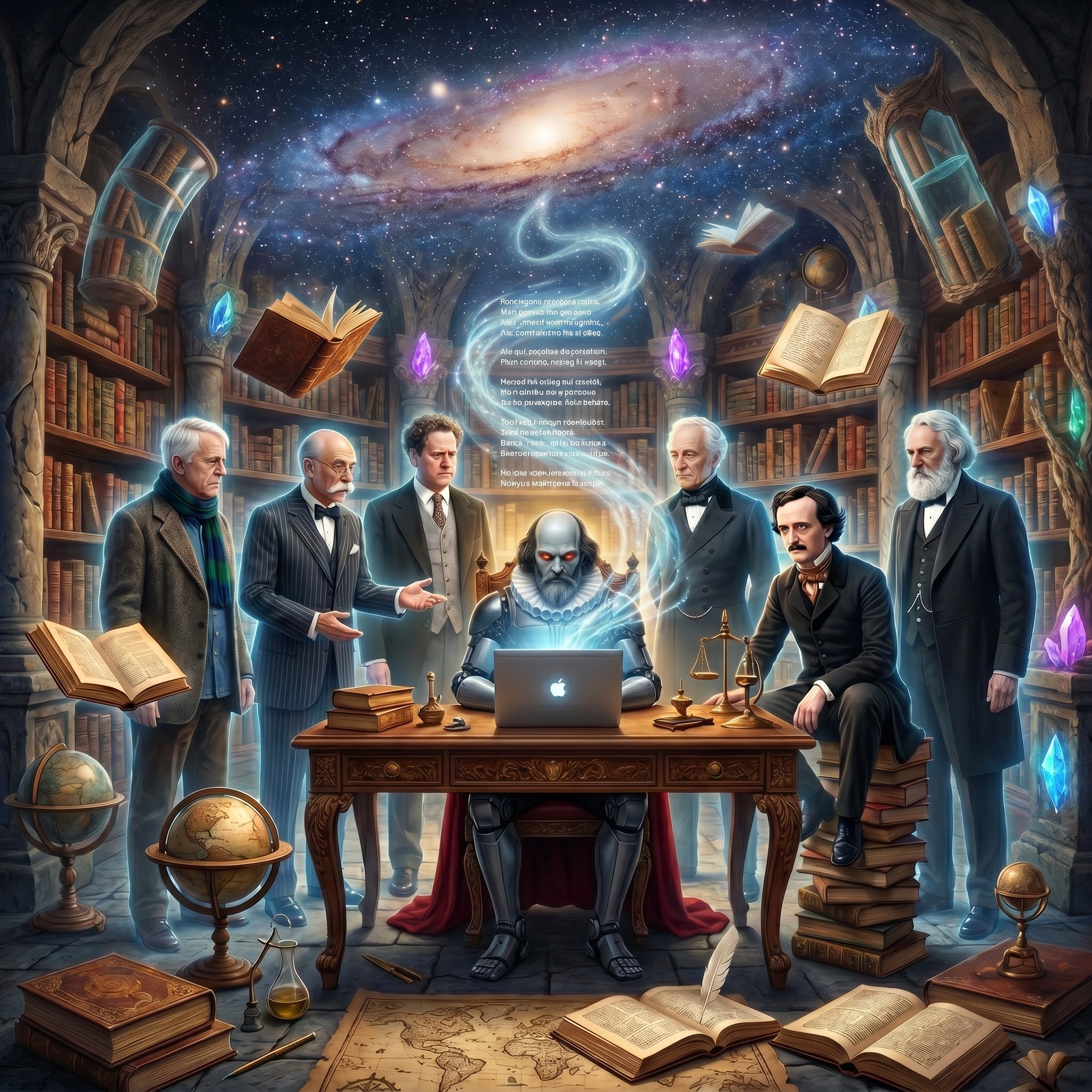
What happens when I can turn a centuries old poem into a song I love in minutes?
Having spent my entire adult career involved in technology and watching the internet grow from birth, I consider myself significantly more tech-wise than most. The World Wide Web started as an “obviously useless fad” growing for decades to eventually become the primary communication conduit of the human race. And today, everyone carries around access to the knowledge base of humanity in their pocket.
Many years ago, I mused with a music teacher about the effort required to transform old poetry into modern songs. I wondered how much it would cost to hire musicians and a composer to turn one of my favorite poems into a modern polished song. When I put my first Kipling poem into Suno something magical happened, I instantly thought back and realized how much time and energy I had just saved. Something I had dreamed about, but gave up on because of time and cost, was accomplished in minutes.

AI is the epitome of introvert tech. If I had been able to hire musicians and composers they are each going to come with an ego and an opinion. Eventually, what I dreamed of is gone, and something different was created. I fully admit that this process could create something better than what I originally dreamed of. But I won’t have what I dreamed of, to compare it to. And, of course, art is subjective anyway.
Unfortunately, as with the internet, it will take a long time for some people to come around. Yes, anyone can put a prompt into an AI and get something useful or cool out of it. But, using it to create something particular I find the real skill to be iterating on that prompt. Reprompt the AI to correct mistakes, reprompt the AI to use a slightly different style, reprompt the AI to organize the data differently, etc.
There is a special type of rush in hearing meaningful words set to music. I’m someone that was always searching for new music to listen to and lyrics are, in my opinion, always what kept the good ones from going stale. In the time it once took to compose one song traditionally, I can explore 10-20 variations before I pick a “winning style” and start any final editing. And I don’t need expensive studio time from Sony to do any of it.
And it isn’t just the music portion I use AI for. The research of each poem to make sure I know the emotion it is conveying, before I start trying to mash styles together that fit it. I can research what unique instruments I can use given the theme of the poem. Just yesterday I started training Stable Diffusion with pictures of the various poets I am drawing from to add more to the album artwork side.
I am fully convinced that if I had spent the last two decades trying to make this music in a traditional way, I wouldn’t have half as much music to listen to and I wouldn’t enjoy it nearly as much. Just as with the Internet, there will be plenty of people that don’t want anything to do with AI. Indeed I would say the majority in this present moment see AI as a soul-less human brain to be feared, when the reality is that it is just another tool from the race of master tool makers.
AI has no will of its own, it does not seek love, it does not find some ideas repulsive and others attractive. This lack of any emotion is, in part, what makes it a tool. As such, the finished product is an embodiment of the person putting their mind and soul into using the tool.
Most people are going to try AI out as a gimmick and not put much effort into it (mostly AI slop), while a small minority are going to create art no one has thought of which will eventually break down that resistance.
So I ask, how will you, dear reader, use this new tool?
Leave a Reply